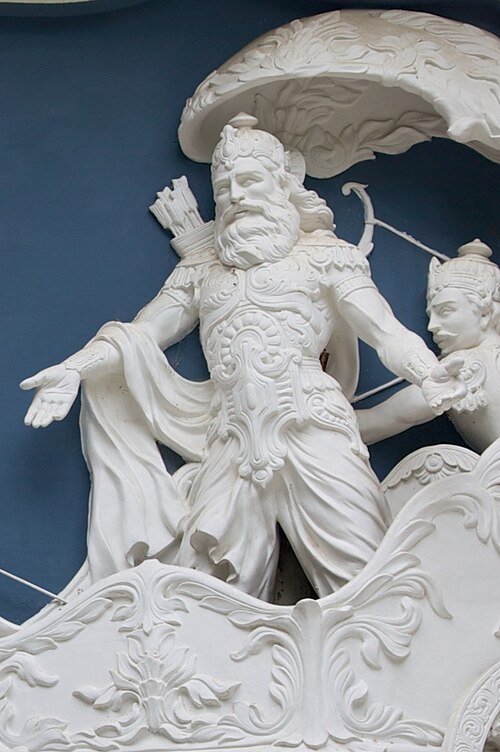
Bhishma is the Mahabharata's great tragedy of excessive virtue. He took a vow at a young man's impulse that locked him into fighting for the Kauravas — a cause he knew was wrong — for the rest of his impossibly long life. He was the greatest warrior alive. He was the most revered elder at Hastinapura. He sat in the court when Draupadi was disrobed and said nothing, because his oath to the throne superseded his own judgment. The Mahabharata uses him to ask: is a virtue taken too far still a virtue?
The Terrible Vow
Devavrata — who would become Bhishma — was the son of King Shantanu and the goddess Ganga. Shantanu fell in love with Satyavati, a fisherman's daughter. Her father refused the match unless his grandson would inherit the throne, not Devavrata. Devavrata gave up his claim to the throne willingly. But Satyavati's father demanded more: that Devavrata would never father children who might contest Satyavati's grandchildren for the throne. Devavrata took the vow of lifelong celibacy on the spot — publicly, before the gods. The heavens rained flowers and the assembled crowd called him 'Bhishma' — he of the terrible vow. He was twenty years old.
A Life in Service of the Throne
Having given up his birthright, Bhishma spent the next century serving whoever sat on the Hastinapura throne. He kidnapped three princesses for Satyavati's son to marry. He trained both Pandavas and Kauravas in warfare. He sat at every key council and offered counsel that was repeatedly ignored. When the dice game happened and Draupadi was humiliated in open court, Bhishma — the most powerful man in the room — looked away. His vow was to the throne. Duryodhana sat on the throne. He could not act.
Fighting His Own Grandsons
When the war came, Bhishma was eighty or more years old — and still the greatest warrior alive. He became the Kaurava commander for the first ten days and devastated the Pandava forces. He could not be killed, because he had the boon of choosing his own moment of death. The Pandavas learned that he would not fight Shikhandi — a warrior born female in a previous life. They placed Shikhandi in front of Arjuna. Bhishma laid down his arms. Arjuna shot him with arrows until he was suspended above the ground, resting on a bed of arrowheads.
The Bed of Arrows
Bhishma lay on his bed of arrows for 58 days, waiting for the auspicious astronomical moment to depart his body. During this time, he delivered the Shanti Parva and Anushasana Parva — two of the longest books in the Mahabharata — teaching Yudhishthira about kingship, dharma, ethics, and the nature of existence. A man dying slowly in agony gave some of the most comprehensive moral instruction in Indian literature. He chose his own moment of death at the winter solstice — Uttarayana, when the sun begins its northward journey.
The Question His Life Poses
Bhishma is the Mahabharata's sharpest test of loyalty and dharma. He was loyal to a fault — literally to a fault that cost the lives of millions. His loyalty to the throne was a virtue taken to a place where it became complicity. He knew Duryodhana was wrong. He told him so repeatedly. He fought for him anyway. The epic asks: at what point does loyalty to an institution become moral abdication? Bhishma's answer was: never. And the Mahabharata treats this as his defining flaw.
Bhagavad Gita Verses Connected to Bhishma
“Then Bhishma, the great valiant grandsire of the Kuru dynasty, the grandfather of the fighters, blew his conchshell very loudly, making a sound like the roar of a lion, giving Duryodhana joy.”
Bhishma opens the war by blowing his conch — the most powerful man choosing the losing side, knowing it is the losing side.
“The Supreme Personality of Godhead said: While speaking learned words, you are mourning for what is not worthy of grief. Those who are wise lament neither for the living nor for the dead.”
Krishna's opening teaching to Arjuna — the teaching Bhishma, lying on his arrow-bed, had already embodied. He did not mourn the war. He waited for death with complete equanimity.
“O best of the Bharatas, I shall now explain to you the different times at which, passing away from this world, the yogi does or does not come back.”
Bhishma waited for Uttarayana — the auspicious time described in this chapter — to leave his body. He had spent his whole life accumulating the merit and knowledge to choose that moment precisely.
What Bhishma's Story Teaches
Bhishma's lesson is about the difference between loyalty and complicity. He was the most honorable man in the epic. He was also the man who, by staying silent at the critical moment, made everything that followed possible. Honor without judgment is not virtue — it is the abdication of judgment in virtue's name.